
Selected artworks from the Government Quarter
Learn more about selected artworks from the newly established Norwegian Government Ministries Art Collection.
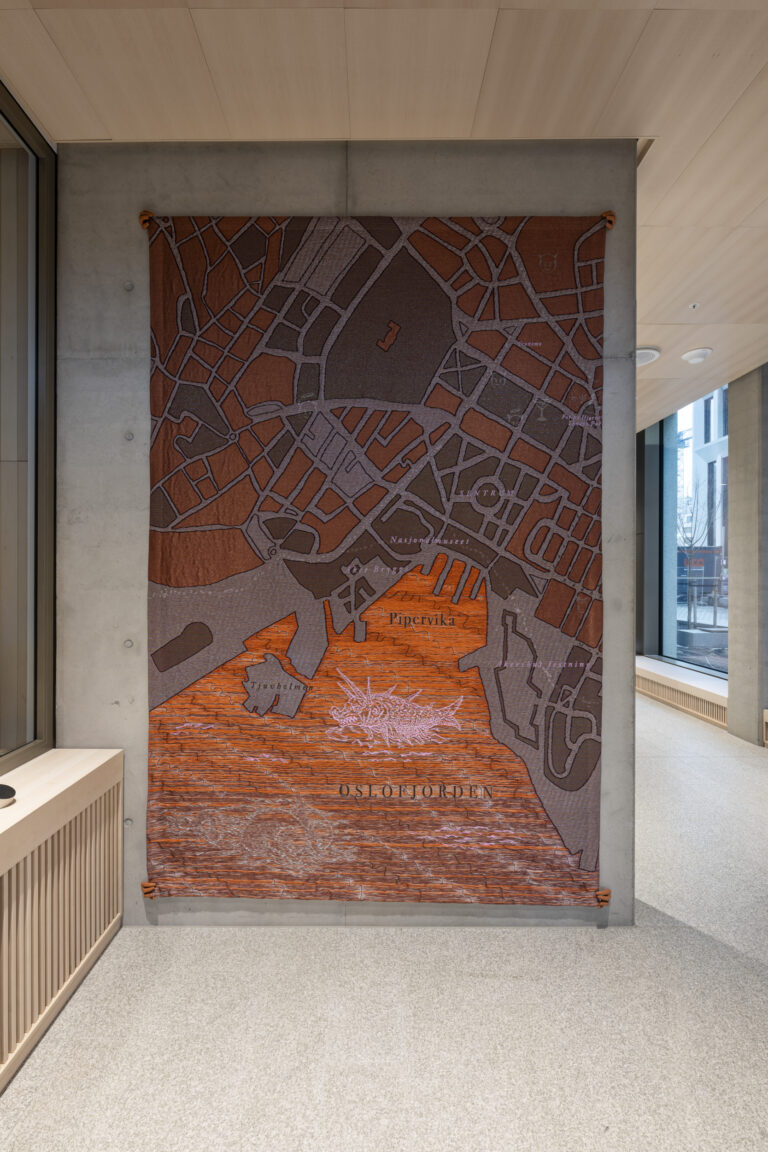
Damien Ajavon (b. 1990)
We Are Here, 2025
Digital jacquard weave in polyester, merino wool, metallic thread, polyamide, viscose, nylon, mohair and thermoplastic polyurethane. 3D-printed hands
Based on historical maps from the City Archives and the Oslo Museum, these two textile works present new, experimental maps of Oslo. The maps combine 19th-century cityscapes with contemporary symbols and place names to explore a capital city in flux. Developed in the 18th century, the jacquard technique allows the creation of complex, detailed textile patterns. Certain areas, streets and symbols are woven with threads that respond to light, UV radiation and temperature, revealing secretive information about certain locations. Inspired by ‘queer mapping’ – a practice developed by the queer community to identify safe spaces and communities – Ajavon creates a personal geography that reflects older and newer layers of the city. The elements are held in place by casts of the artist’s own hands.
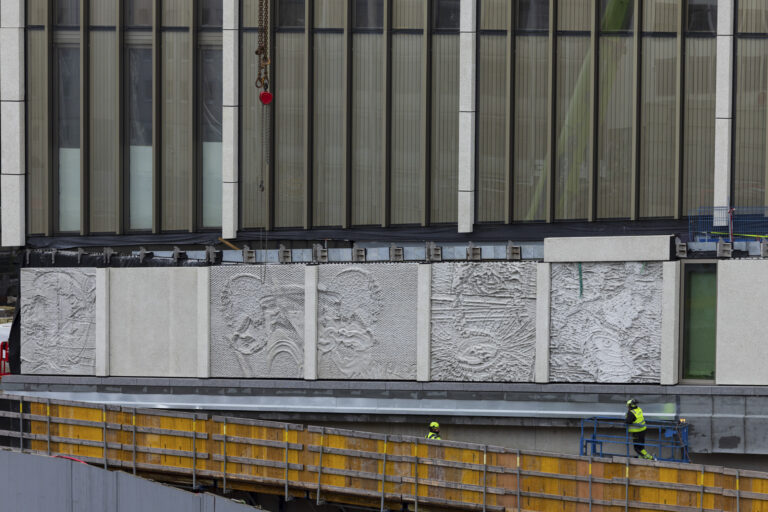
Damla Kilickiran (b. 1991)
Sites of a Breach, Delays in a Dream; A Surface Half Asleep, 2024–25
Fibre-reinforced concrete
Integrated with the foundation wall of the A-block are a total of ten panels with sculptural reliefs; seven are oriented towards the Government Park, three towards Grubbegata. The artwork is based on the artist’s archive of photographs taken at various locations across Norway. The photographs capture changes, places, material processes and semantic details that are slowly disappearing or just emerging – details we might not otherwise notice. After analogue and digital processing, the images were cast in grey fibre-reinforced concrete, which allows a broader range of subtle variations in colour and texture than the rest of the building. The material also echoes the ‘natural concrete’ technique used by the architect Erling Viksjø in the 1950s to embellish the façade and stairwell of the Cabinet Building with specially commissioned artworks.
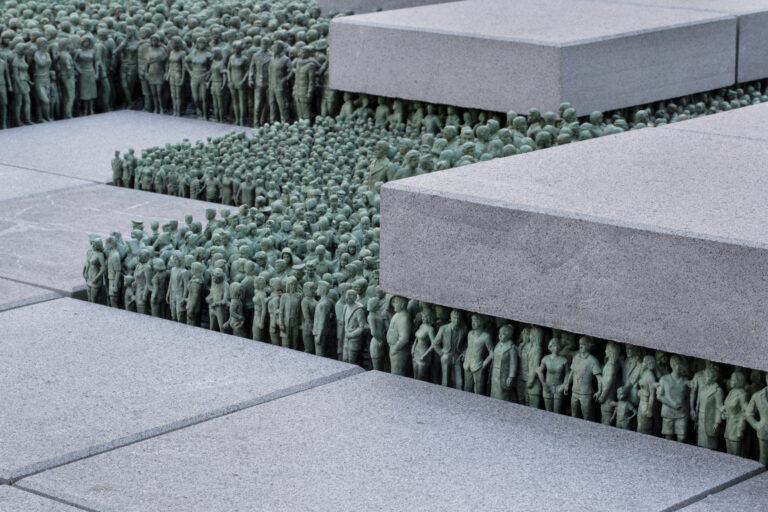
Do Ho Suh (b. 1962)
Grass Root Square, 2012
Cast bronze figures with green patina
The artwork consists of 50,000 small figures emerging from the pavement. From a distance, the details are hard to discern. One hardly notices there is anything there. On closer inspection, one discovers that above, between and beneath the granite slabs are thousands of small figures of various sizes, shapes, genders and ages. Collectively, these figures represent the grassroots, the general population. Here it is the common people who dominate the public space, rather than the social elite, ministers of state, or royalty, as has typically been the case throughout history.
Originally commissioned by KORO for the R6 government building in Teatergata in Oslo, this work was relocated in 2024.
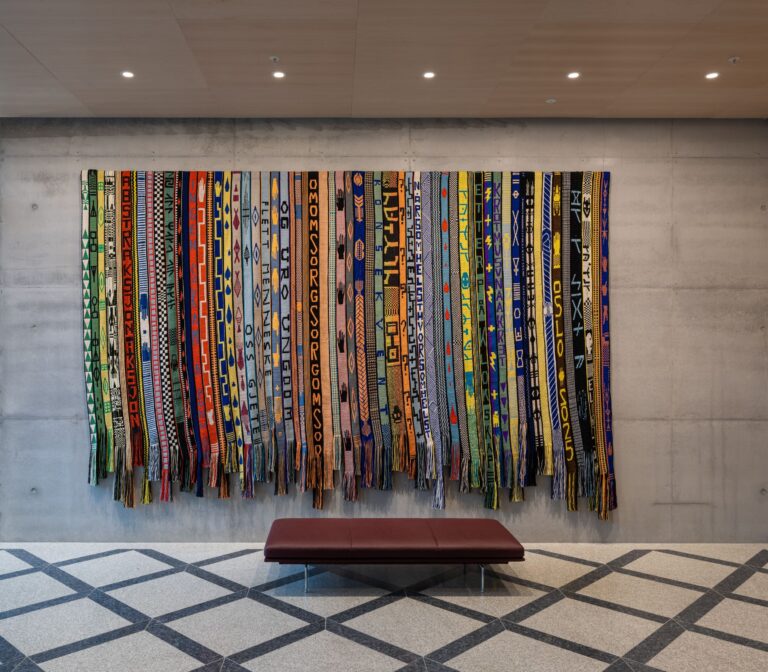
Elise Storsveen (b. 1969)
KYSMIK, 2025
Tablet-woven woollen belts
The many different belts are woven from thick yarn made from the wool of Norwegian Spelsau sheep. Tablet weaving is an ancient technique that has been passed down since nomadic times, via the Viking Age, and survives today in the belts of the traditional bunad costume. Among the items found together with the Viking ship at the Oseberg burial mound near Tønsberg was a threaded tablet loom. The title of the work links it to another archaeological find: a runic inscription on a cattle bone unearthed in Gamlebyen in Oslo, meaning ‘kiss me’. The woven patterns combine ornamental borders, fragments of texts and magical symbols from various cultures. The symbols serve as protection from evil forces and declarations of solicitude and love.
Woven by Ella Aandal, Jenni Friis Bjørgli, Elin Jarnehäll, Emma Elise Ødegård Olsen, Nelly Riverlou and Elise Storsveen.
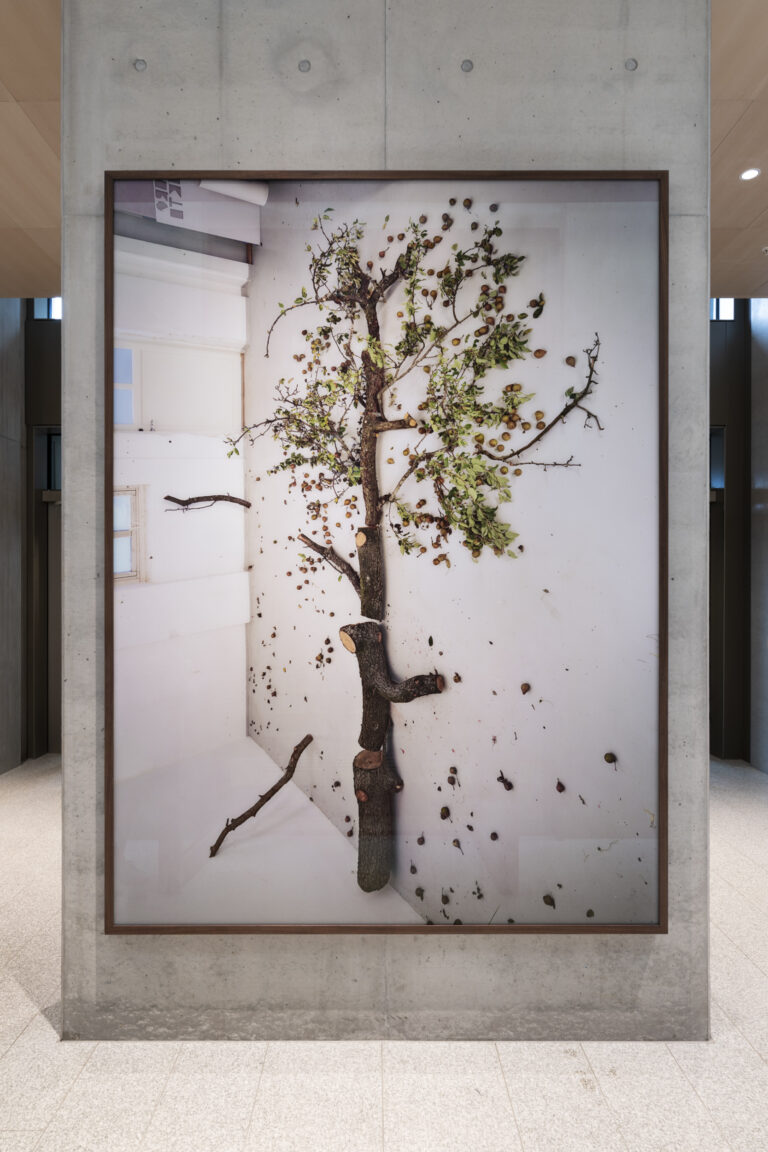
Else Marie Hagen (b. 1963)
Returns, 2024/2026
Pigment print on cotton paper from analogue photographs
The starting point for this work was a pear tree that blew over in a storm. After it had been cut up ready for removal, Hagen was able to save parts of the tree and take them to her studio, where she photographed them. In this work, she has attempted to restore the tree by reassembling the trunk and branches. Whereas the pieces were laid out flat on the floor, the finished photographs are oriented vertically, giving the impression that the tree is standing upright. While the creative process is a homage to the life cycle of this one specific tree, it simultaneously illustrates one of the strengths of art: its capacity to recombine things in new ways and to turn realities on their head.
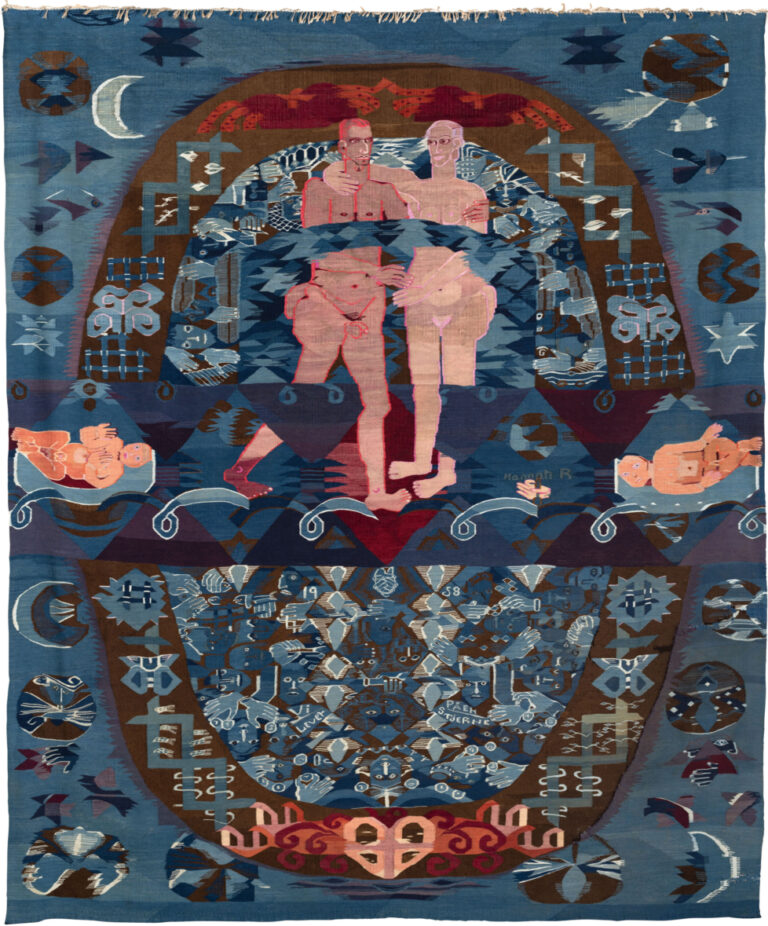
Hannah Ryggen (1894–1970)
We Are Living on a Star, 1958
Tapestry in wool and linen
The Swedish-Norwegian artist Hannah Ryggen trained as a painter, but became known even during her lifetime for her many tapestries. Rich in references to art and history, her works frequently convey political and anti-fascist messages and social critique. Love is another recurring theme.
We Are Living on a Star was commissioned by Erling Viksjø, the architect behind the Cabinet Building (aka the High-rise). The work was damaged in the terror attack of 22 July 2011. Towards the lower right, a large tear is still visible, despite careful restoration. A plaque that hung beside the work in the Vestibule of the Cabinet Building for fifty-three years read: ‘Property of the Norwegian State. The Government Building. The mysteries of the universe and the central role of love in our world.’

Hannah Ryggen (1894–1970)
Trojan Horse / Picasso Tapestry, 1949/56
Tapestry in wool and linen
Acquired for the Cabinet Building in 1958, the tapestry consists of two parts. Trojan Horse on the right was completed in 1949, Picasso Tapestry in 1956. Ryggen joined the two pieces together to form a single work, which hung in the Council Chamber in the Cabinet Building until shortly after 22 July 2011. The work contains many references to mythology, art history and modern art, such as the Greek figures and the artist Pablo Picasso, who is depicted in the left-hand panel with a palette in his hand. Hannah Ryggen chose these two tapestries for the Council Chamber because she considered it important that when governments are making their decisions, they should be conscious of the fact that history unfolds through both rupture and continuity.
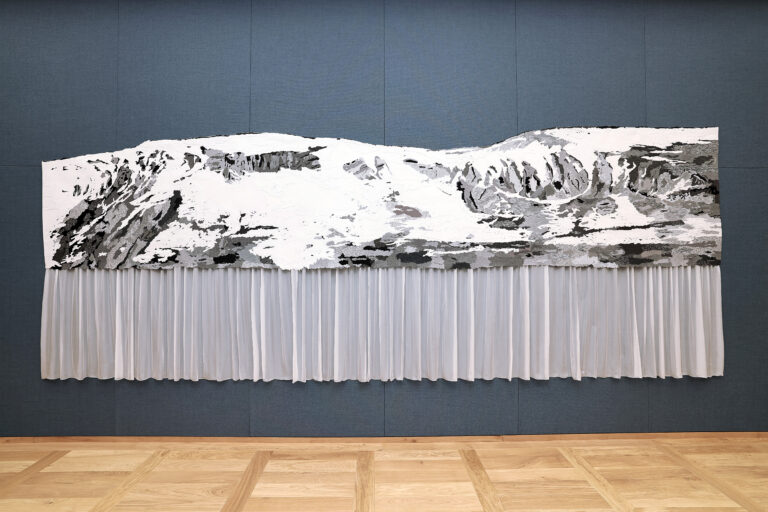
Hilde Skancke Pedersen (b. 1953)
Bassi várri, giddadálvi – Sacred Mountain, Spring Winter, 2025
Fabric scraps from used garments and worn sheets, ironed onto white cotton fabric using Vliesofix; valance of silk chiffon
The artwork is a portrait of a broad mountain landscape on the Norwegian side of Sápmi. The materials emphasise the work’s inherent message that the earth’s resources are limited and nature must be protected. The mountains are depicted as a sacred space that must not be harmed by humans. Giddadálvi denotes the months following the dark season and is part of the Sámi system that divides the year into eight seasons. In ‘spring-winter’, the reindeer are still on their winter pastures, but the days are getting longer. Thus the title holds the promise of brighter times ahead, in contrast to the global situation in the year the work was created.

Irma Salo Jæger (b. 1928)
The Birds Take off in Flocks, 1985
Fired stoneware with slip decoration
After moving to Oslo in the 1950s, the Norwegian-Finnish artist Jæger became a key figure in the development of the abstract-geometric style of painting in Norway. Many people are familiar with her large-format paintings, but she also created a number of works for public spaces. This work was originally created for a government office building at Helsfyr. For its relocation to the current site, the work was reconfigured in close collaboration with the artist to suit the new setting. It is a rare example of a wall-mounted sculpture by the artist, who is best known for her abstract paintings. Juxtaposed with the large windows in the room, the image of abstract birds taking to the air establishes a link to the sky outside.

Jumana Manna (b. 1987)
Sebastia, 2025
Integrated stone installation
The city floor is an 800-square-metre artwork made from stones donated and collected from local authorities and other organisations throughout Norway – in total, one hundred different sources. The material includes paving slabs from Stavanger, stones from a bridge in Drammen, an old church in Namsos, Nidaros Cathedral in Trondheim, the Royal Palace in Oslo, and factories and power stations in Kistefos and Tinn. There is marble from Fauske, limestone from Brønnøy, masic quartzite from Finnmark and cobalt from the Blaafarveværket mine in Modum.
All the stones were previously used in Norway, although some originate from other parts of the world. Together, this recycled material forms an image of participation and democracy, reminding us of the importance of a sustainable approach to the use of shared natural resources. The title references the ancient town of Sebastia in Palestine, one of the oldest continuously inhabited settlements in the Eastern Mediterranean. An important historical site, Sebastia has yielded archaeological traces of various civilisations stretching back three millennia.
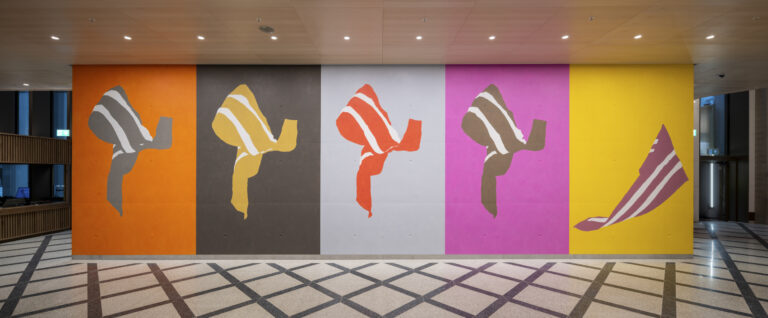
Mari Slaattelid (b. 1960)
MEMENTO, 2025
Acrylic on concrete
The word ‘memento’ is literally the Latin command to remember. On either side of the concrete wall is a series of five pennants. The pennant is a familiar marker of ownership and presence; it signifies that those who have the right to be here are actually present.
The series of pennants is intended as a reminder that the people of Norway have a stake in and are ‘at home’ within these walls and that those who work here do so on behalf of the Norwegian people.
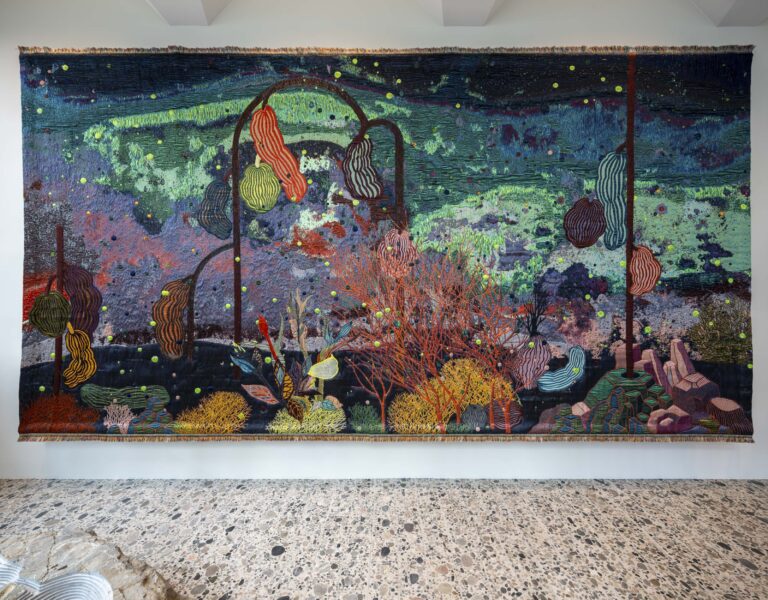
Otobong Nkanga (b. 1974)
Morning Glory – Where One Lingers, 2025/26
Digital jacquard weave, stone and wood
Containing a series of interwoven references to minerals, plants and marine organisms, this monumental textile work can be seen as a tribute to nature’s capacity for renewal, self-healing and growth. The stone sculpture combines expanses of raw, untreated surface with others that are finely polished, thus balancing unspoilt nature with human intervention. Crafted from seven types of wood native to the Nordic region, the wooden element emerging from the stone brings the themes of the tapestry into the space. The types of stone used in the work are orthoceras limestone, Porsgrunn limestone and Tønsbergite.
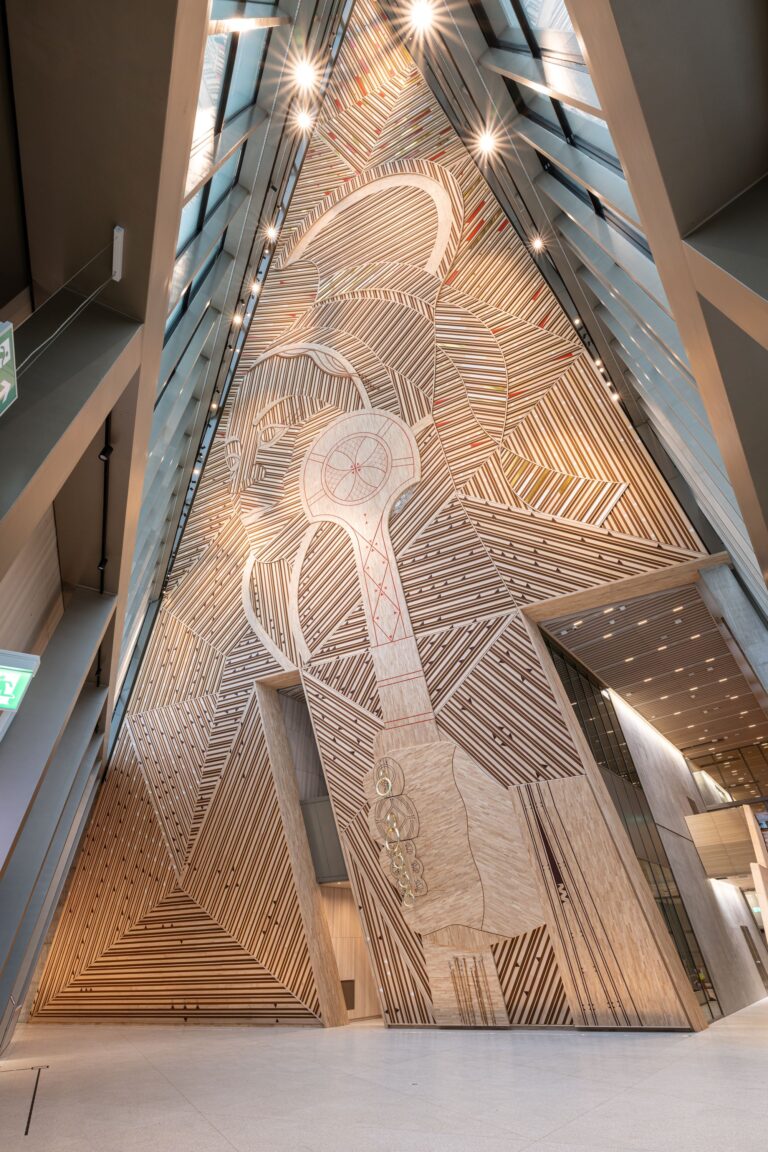
Outi Pieski (b. 1973)
AAhkA, 2025
Wall installation in birch, gold leaf and brass. 11 walking staffs of duodji-crafted birch and reindeer antler
AAhkA is a stylised portrait of a woman, a personification of Mother Earth. As a protector of nature, she reminds us that humankind, nature and all that it supports and nurtures stand in a reciprocal and equal relationship. The work contains numerous references to traditions, duodji (Sami crafts), history and culture from across Sápmi. AAhkA is wearing a ládjogáhpir, a traditional hat, and holding a woman’s walking staff. The walking staffs at the base of the work were crafted by the Sámi duojár craftsmen Johannes Nilsson, Per-Stefan Idivuoma and Nils-Johan Labba.
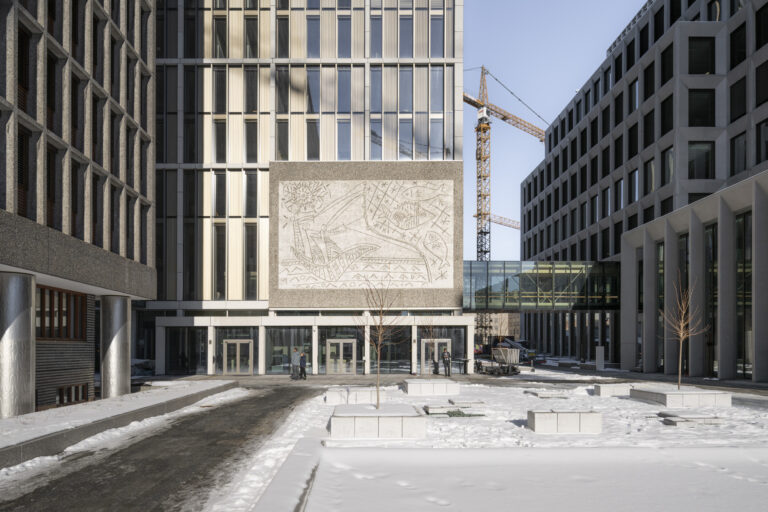
Pablo Picasso (1881–1973)
The Fishermen, 1969
Sandblasted natural concrete. Sandblasting carried out by Carl Nesjar (1920–2015) after a sketch by Picasso.
Picasso took his inspiration for this depiction of traditional net fishing under a brilliant sun from the fjords and seafaring culture of coastal Norway. The work depicts a scene of life beside the sea as it was before the era of oil, with a sun that symbolises the union of two distinct coastal landscapes: those of the cool Nordic region and the warm Mediterranean. Picasso presented the design as a gift to the Norwegian people. Originally, The Fishermen was executed as an artwork integrated with the architecture of the Y-block. Having sustained only negligible damage in the terror attack of 22 July 2011, the entire concrete wall in which it features was preserved before the Y-block was demolished in 2020. The Fishermen was installed on the façade overlooking Einar Gerhardsens plass in 2024.
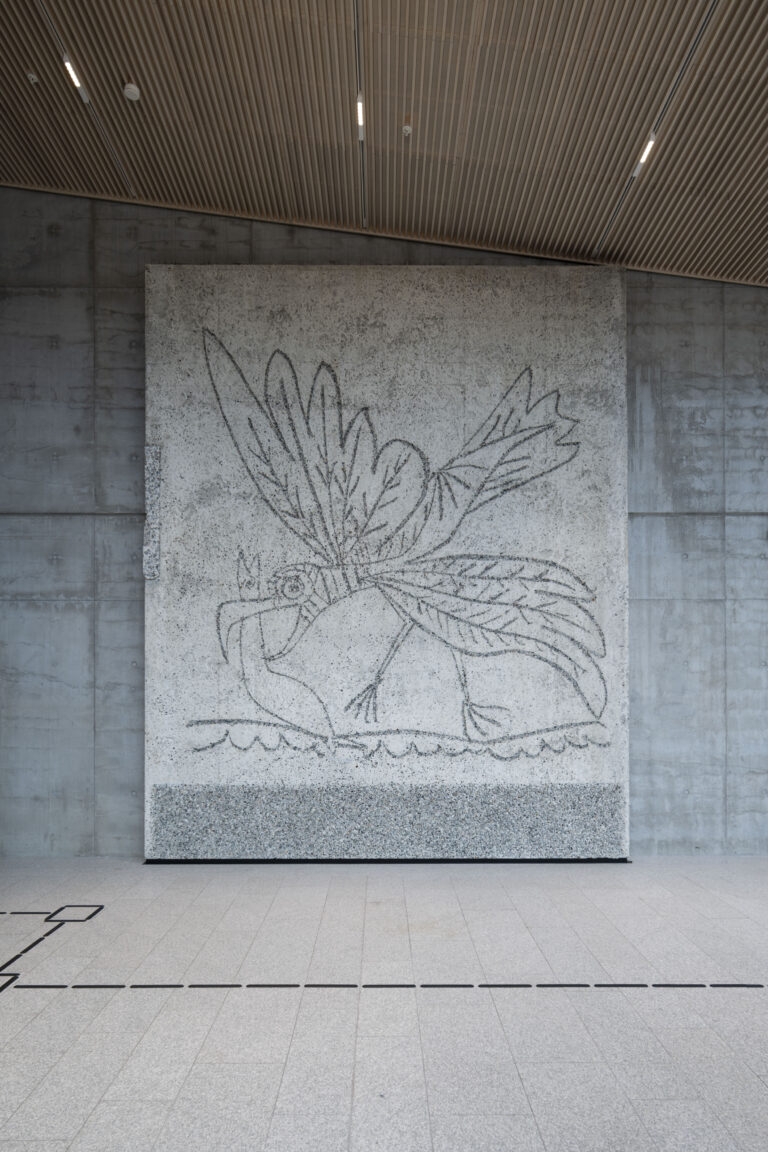
Pablo Picasso (1881–1973)
The Seagull, 1969
Sandblasted natural concrete. Sandblasting carried out by Carl Nesjar (1920–2015) after a sketch by Picasso.
The design shows a seagull in the act of catching a fish from the sea. Although he never visited Norway in person, Picasso drew inspiration from the country’s fjords and coastal culture. Many aspects of coastal life are universal, and the seagull is a familiar sight wherever the sea is close. Originally, The Seagull was sandblasted directly into one of the walls of the Y-block as an artwork integrated with the architecture. Having suffered only minor damage in the terror attack of 22 July 2011, the concrete wall featuring the artwork was cut out and preserved before the Y-block was demolished in 2020. The Seagull was installed in its new location in 2024.
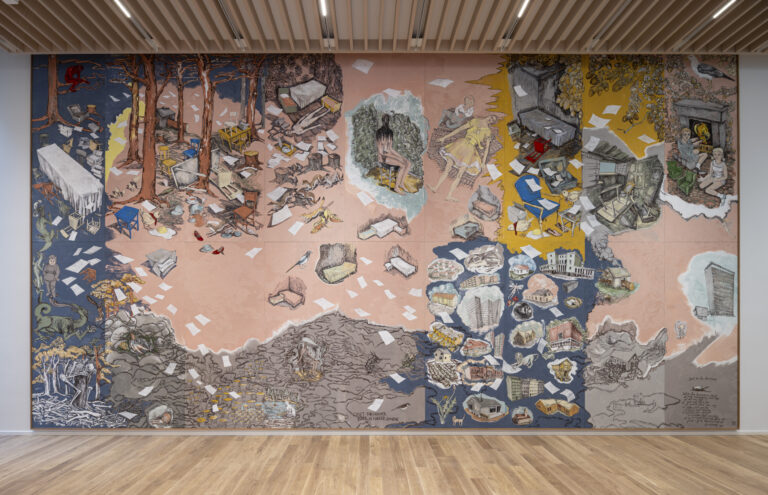
Vanessa Baird (b. 1963)
Light Disappears As Soon As We Close Our Eyes, 2012
Silicate paint on fiber cement façade panels
Three large murals adorn the space in and around Kafé 1814. They were originally commissioned for the R6 ministry building in Teatergata. In 2010, KORO invited the Norwegian artist Vanessa Baird to create works for the new building, which was completed in 2012. This painting hung in the press room at R6, until it was moved and installed here in 2026.
Baird’s works are both chaotic and beautiful. They can be viewed as brutal and despairing, but also convey humour and satire. They contain a wealth of references to culture and nature, bureaucracy, fables and folk tales. Here we see typical Norwegian houses and other structures, abandoned cabins and weary mothers. The sheets of paper fluttering across the composition tie the many smaller scenes together. The painting offers broad scope for interpretation.

Vanessa Baird (b. 1963)
For A Long Time I Went Early To Bed, 2013
Silicate paint on fiber cement façade panels
The three paintings located in different parts of Kafé 1814 were originally created for the R6 ministry building in Teatergata. KORO invited Baird to create the works for the new building, which was completed in 2012. The second painting in the series, this work hung in the council chamber of the Ministry of Agriculture and Food until it was moved here in 2026.
Baird’s pictures are both chaotic and beautiful. They can be viewed as brutal and despairing, but also convey humour and satire. They contain a wealth of references to culture and literature, nature, bureaucracy and human vulnerability. ‘For a long time I went early to bed’ is the opening sentence of Marcel Proust’s great novel In Search of Lost Time (published 1913–1927).

Vanessa Baird (b. 1963)
To Everything There Is A Season, 2014
Silicate paint on fiber cement façade panels
The three large paintings hanging in and around the café area were originally created for the R6 ministry building in Teatergata. KORO invited Vanessa Baird to create works for the new building, which was completed in 2012. The first two paintings, Light Disappears As Soon As We Close Our Eyes and For A Long Time I Went Early To Bed, hung in R6 until they were moved to the A-block in 2026. This painting was intended for the Ministry of Health and Care Services.
Baird’s works are both chaotic and beautiful. They can be viewed as brutal and despairing, but also convey humour and satire. The fluttering sheets of paper suggest tedious bureaucracy, case documents, laws and decisions that impact the fate of individuals. After 22 July 2011, Baird’s pictures also triggered painful memories of the terror attack of that day. As a result, this work was temporarily housed in the premises of Arts Council Norway, where it remained on display until it was moved to the Government Quarter in 2026.
Var dette nyttig?
Takk for din tilbakemelding!
Takk for din tilbakemelding!
Vi leser alle henvendelser, men kan dessverre ikke svare deg.