The city floor of the New Government Quarter
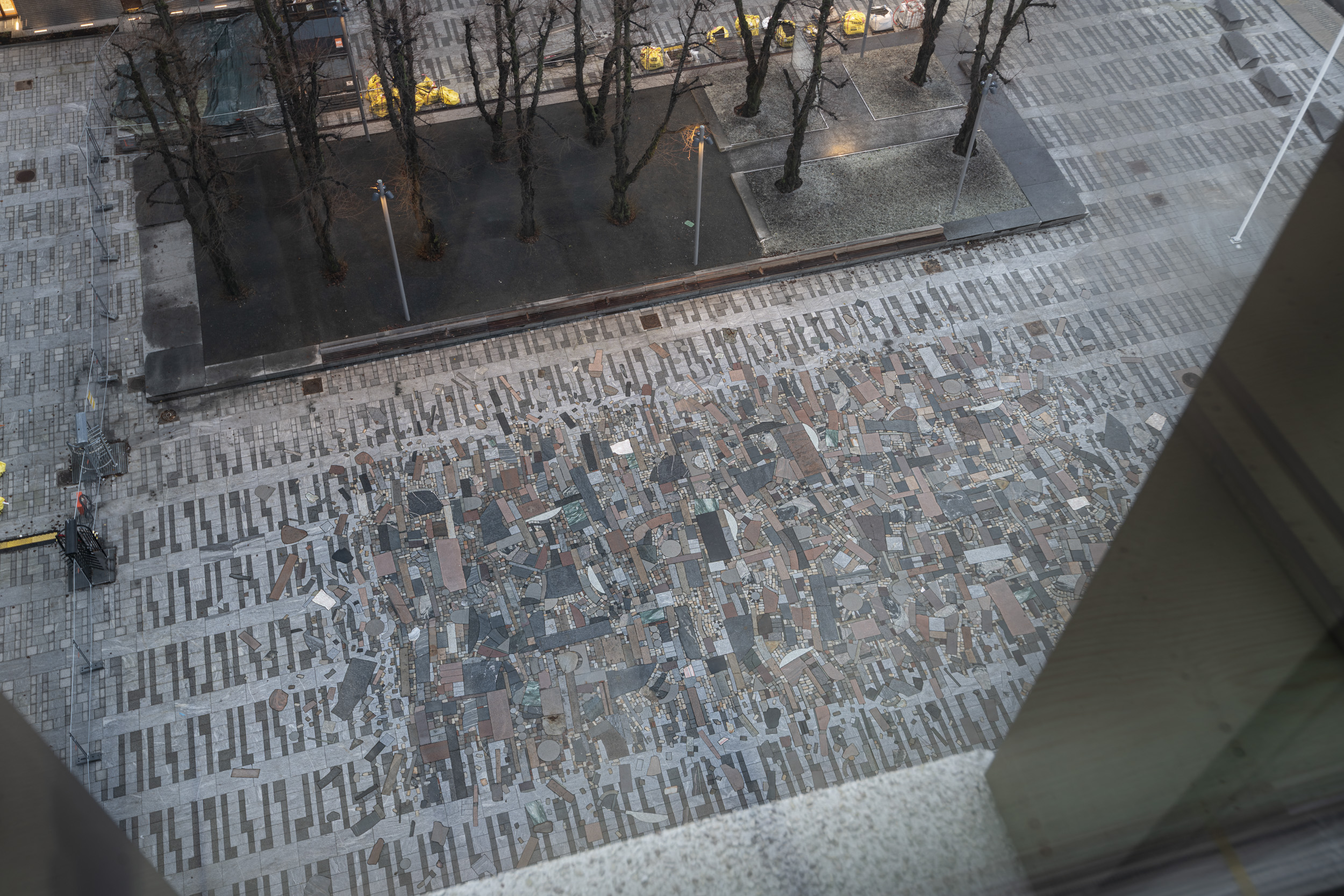
One of the biggest and most visible spaces in Oslo’s New Government Quarter is the city floor, accessible to all who pass through or visit the area. The artist Jumana Manna completed in the autumn of 2025 the artwork Sebastia, working on the design since 2022.
About the project
The city floor at Johan Nygaardsvolds plass facing Akersgata is one of the largest publicly accessible spaces featuring art in the new Government Quarter. KORO invited ten artists to submit ideas for an artwork for the city floor. In autumn 2022, the jury selected the proposal from the Berlin-based Palestinian artist Jumana Manna. The work itself was completed in autumn 2025.
With the title Sebastia (the earlier working title was Substitute), the work is an 800 m2 paved surface made of reclaimed stone collected from right across the country. For more than 300 years, stone, and especially granite, has been used throughout Norway in civic and urban spaces, and in industrial and defensive structures.
Stone from across the country
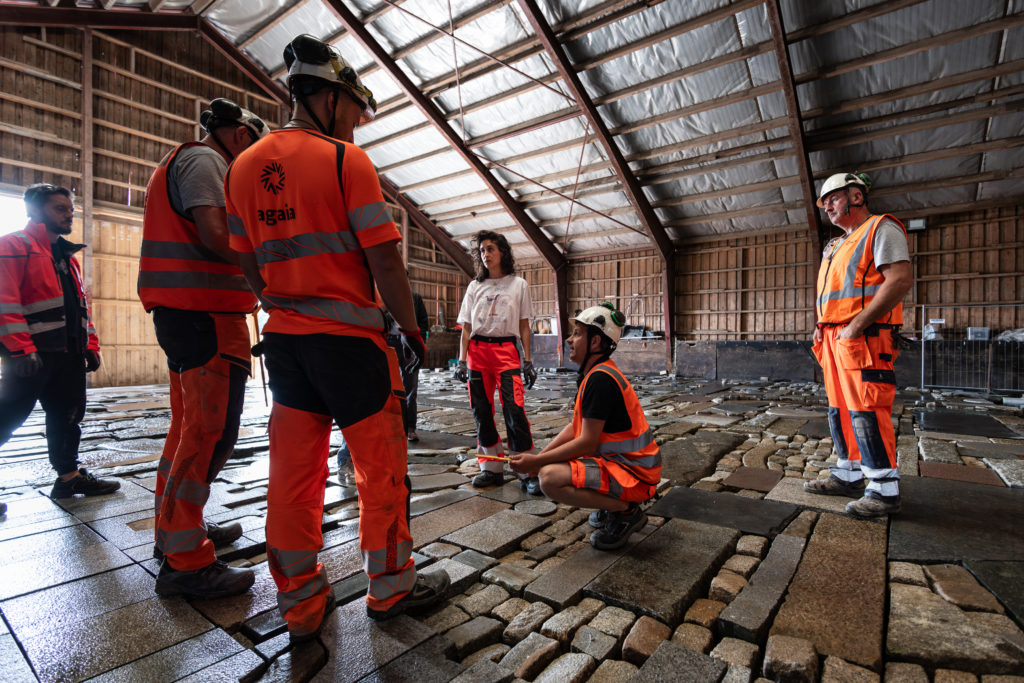
Municipalities in every corner of Norway were invited to donate stone for the project. The resulting work combines a broad variety of stones from public pavements, walls, dams, power stations, churches, town halls, schools and farms. Derived from more than a hundred sites throughout Norway, this material unites the country in a single artwork, while also showing the importance of sustainability in the use of natural resources and of a circular economy. In her project description, Jumana Manna wrote:
My proposal explores Norway’s material history in relation to nature and the extraction of resources, economy and identity. Through this work, I will explore recycling or reuse as a conceptual and infrastructural ethic, and highlight the idea that something must be given up in order for the collective to continue to live and grow sustainably together.
Donations for the city floor include stone from the ruins of Hamar Cathedral, soapstone from Nidaros Cathedral, cobble stones from Tromsø and Tønsberg, stones from parks and nature trails in Kinn and Sigdal, sauna stones from Kibyfjæra in Vadsø, stone from the construction of Bergen Light Rail, stones from Lervigkaien in Stavanger and the Telemark Canal, stones from factories and power plants, such as Kistefos and Tinn, marble from Fauske, limestone from Brønnøy, and cobalt from Blaafarveværket, stone from public buildings such as the National Library in Mo i Rana, the Royal Palace and the National Museum in Oslo, stone from Christiansholm and Fredriksten Fortress. And much more besides.
The reuse also recalls the ancient tradition of spolia (Latin), which gave new life to stones from ancient ruins and older buildings and sculptures by incorporating them in new constructions. For several thousand years, similar practices have played a part in cultures around the world.
Archaeological layers
The title also references historical strata and recycling. After considering several alternatives, Manna chose the title Sebastia, the name of an archaeological site and village in the Palestinian West Bank. Built on layers of archaeological history, Sebastia is one of the oldest continuously inhabited villages in Palestine. Its history stretches back to the Bronze Age and encompasses, among others, Israelite, Assyrian, Persian, Hellenistic, Roman, Byzantine, and Palestinian cultures.
Jumana Manna has long drawn inspiration from archaeological sites and objects – from the patina of time that builds up layer upon layer, the traces of hands and soil, and the sense of wonder that incompleteness and abstract fragments evoke in us. The mosaic of donated stones at Johan Nygaardsvolds plass is a fragmented city floor that hints at ruins yet resists a clear narrative. Instead, it invites visitors to wander through centuries of interwoven stories.
Completed in late autumn 2025, the artwork is already open to the public.
As one of the largest publicly accessible spaces in the new Government Quarter, the square and the city floor will be the setting for events of many kinds, large and small: ceremonies, demonstrations, speeches and general public life.
The website sebastia.koro.no
As part of the artwork, Jumana Manna has developed a website featuring an interactive map where the public can explore the origins of the stones and learn about their histories.
Click on the link below to explore the map and the stories behind each stone.
Jumana Manna (b. 1987) grew up in Jerusalem, and lives and works in Berlin. Manna studied at the Academy of Fine Art in Oslo. Through film, sculpture and installations, she investigates storytelling linked to power, language and memories. For the artwork Government Quarter Study from 2014, she took full-size casts of the columns from the interior of the Høyblokka government building. The artwork was shown in the Henie Onstad Art Centre’s widely discussed exhibition in 2014, We Live on a Star, which discussed the events in the Government Quarter during the attacks of 22nd July, 2011. The work was later shown in the Nordic Pavilion during the Venice Biennale in 2017.

Var dette nyttig?
Takk for din tilbakemelding!
Takk for din tilbakemelding!
Vi leser alle henvendelser, men kan dessverre ikke svare deg.